Pub date: December 1, 2025
ISBN: 9787302703990
Rights: All Rights Available
228 p.p.
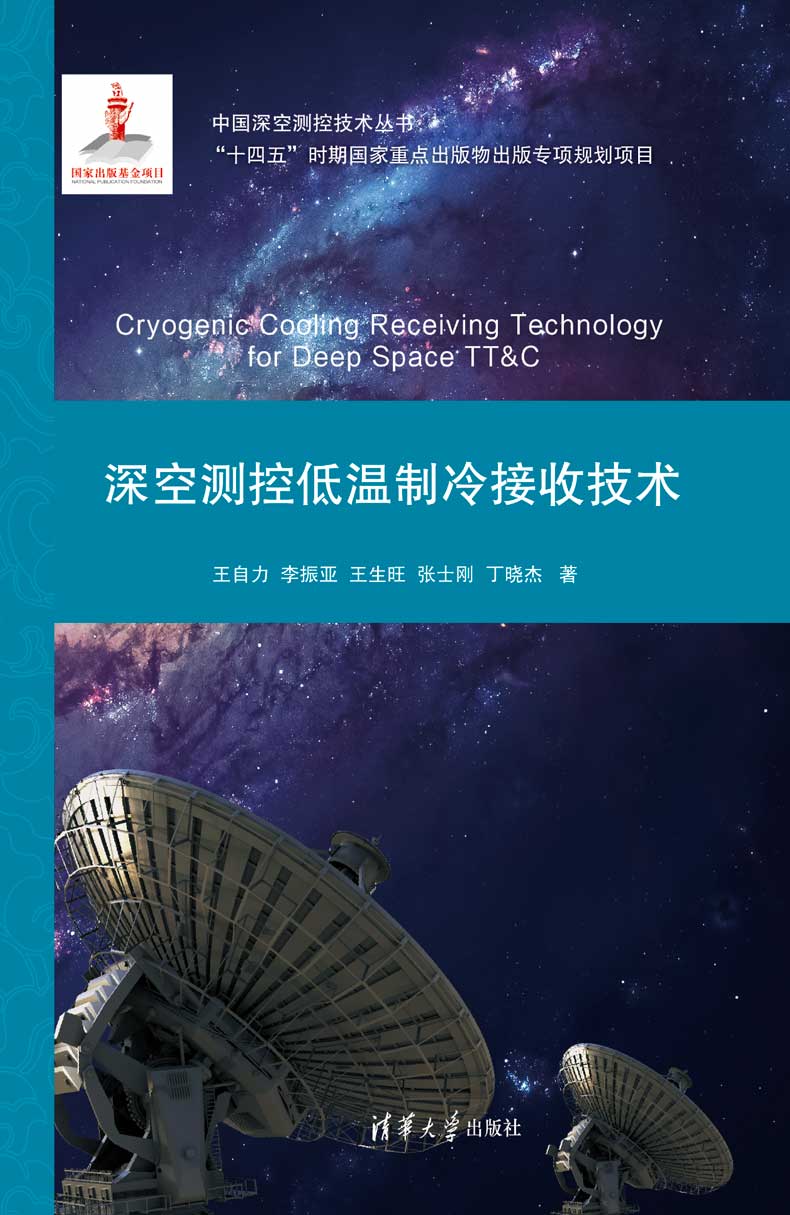
The book reveals the reason why cryogenic refrigeration receiving technology can achieve high-sensitivity reception by introducing the composition of the cryogenic refrigeration receiving front-end and the design of core components such as low-noise amplifiers and superconducting filters. The book consists of seven chapters, which comprehensively discuss cryogenic receiving technology from the perspectives of system noise concepts, composition of cryogenic receiving frontends, design of core components such as cryogenic amplifiers, and low-noise measurement.
Chapter 1 introduces the development history of cryogenic receiving technology. Chapter 2 presents the basic concepts of low-noise technology. Chapter 3 focuses on the composition and key technologies of S/X/Ka-band cryogenic receiving frontends for deep-space stations. Chapters 4, 5, and 6 discuss the design of cryogenic amplifiers, superconducting filters, and cryogenic isolators respectively. Chapter 7 highlights low-noise measurement techniques.
This book is intended for designers and practitioners in the fields of communication systems, radio astronomy, and space research.
WANG Zili joined the 16th Research Institute of China Electronics Technology Group Corporation (CETC) in August 1994, and he is mainly engaged in the research and development of microwave and millimeter-wave products, as well as the research on high-sensitivity weak signal detection technology based on cryogenic and superconducting devices.
LI Zhenya has been engaged in military scientific research and national defense applications for 36 years, undertaking work related to military scientific research, multi-domain organizational management, and institutional leadership.
WANG Shengwang currently serves as the Deputy Director of the 16th Research Institute of CETC, with his main research fields including Cryoelectronics, Superconducting Technology, and Microwave and Millimeter-wave Technology.
ZHANG Shigang's main research fields are Cryoelectronics and Microwave and Millimeter-wave Technology.
DING Xiaojie's main research fields are Cryoelectronics and Superconducting Technology.